

"Just tidying, dear. . ."

Happy spring renewal season, whatever you call it: Easter, Passover, or the ancient pagan tradition of Ostara, which honours Oestre, the goddess of dawn, light and rebirth. I’m grateful for the light coming earlier in the morning; it’s easier for me to get up. And if the day happens to be sunny, what a pleasure, a simple and delightful magic to be outside. May you be well, and if possible, feast with family and friends!

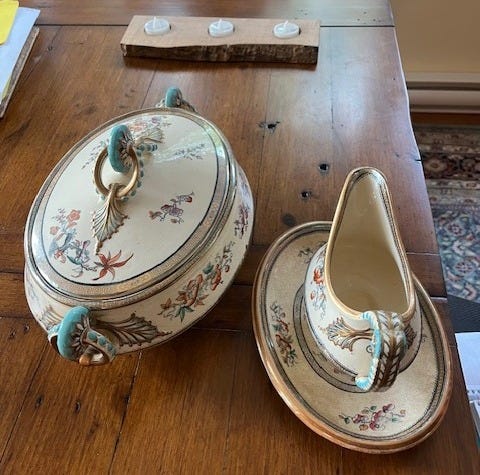
Our mother had a particular phrase that my sister and brother use to this day; even thinking of it makes me smile. In my family, like many others, the rule was that the cook didn’t clean up, especially on holidays. It was someone else’s job to take over the dirty kitchen with its pots and pans, a gravy boat, more plates than it seemed a family could possibly use, and several vegetable tureens that had belonged to my great-grandmother. This was our good china, which couldn’t be washed in a dishwasher, and was only brought out for special occasions. The dishes had shiny bronze-coloured paint around the edges, which a dishwasher would have destroyed. Every Christmas, Easter, Thanksgiving and birthdays, the good china made its appearance. My family wasn’t religious; these were grand reasons to get together and celebrate with good food.
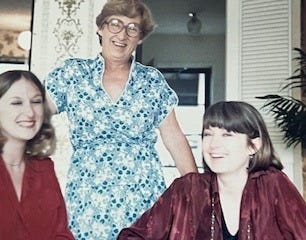
As my brother and sister and I grew, we moved away, and came back for visits while Mom stayed put in her Richmond townhouse. However, on the occasions when we were back and especially where all three of us overlapped, Mom put on a celebratory meal. We loved getting together. My family certainly have had our share of disagreements, but in general, I find them terrific company. They’re smart, informed people. We love telling stories, putting on accents, and riffing on one another’s atrocious puns. There’s a lot of laughter in every visit.

At some point in the after-dinner conversation, someone would look around and go, “Where’s Mom?”
“Barbara, you’re not doing the dishes, are you?” my husband would call. “We’re going to do them, we told you.”
From the kitchen, Mom would call, “No, I know the rules. I’m just tidying, dear!”
And when I went out to the kitchen to drag her back into the living room, the “just tidying,” would have made an astonishing impact on the previously disaster-area kitchen.
The ridiculous thing was how this “just tidying, dear,” trick would be repeated several times in one evening.
“Mom, why are you doing this?” I asked her at one point. “Just slipping away to the kitchen?” Mom was sitting on the beige Ikea couch my sister had bought, with her beloved dog, Patti, curled up beside her with her head in my mother’s lap. Patti was an elegant black-and-white English shorthaired pointer.

“My family didn’t get along,” Mom said. “And you do. It gives me such joy to listen to you kids carrying on. And when I do a little bit of tidying, it gives you more time to be together.” She had such a tender smile.
“We could still visit when we’re doing dishes,” my daughter pointed out. At that time, she was around ten, and it was my guess that at the first hint of dishes, she’d slip upstairs to watch TV. But I kept my skepticism to myself.
“It’s different,” Mom said, stubbornly.
Gradually, over the years, the story I teased out from my mom was that her mother, my grandmother, Josie, had two brothers. The family was prosperous. They owned a pottery manufacturing plant in Ontario and had servants. My great-grandmother was an artist and my great-grandfather was an MP.
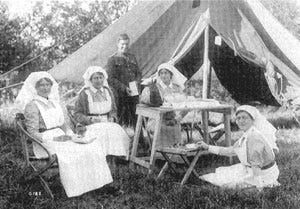
At the time of her mother’s death–she of the fancy dishes that we were using on special occasions–Josie was a widow with two young children. I have no idea how she supported those kids. Josie was a trained nurse who served with the Canadian army in World War I, on the frontlines in France. But could a tiny military pension have supported three people? Even with another one from her husband, my grandfather, who also served in WW1? Had Josie sold a house and lived on what was left? Her husband had been a dentist and I remember Mom telling me that during the Depression, a lot of patients had paid him in chickens and eggs. The family had eaten well, but they didn’t sound rich.
“Why didn’t Josie just go back to nursing after your father was killed?” I asked my mother on more than one occasion. My grandfather had died in an accidental shooting when my mother was fourteen.
My mother said, “Because married women didn’t work in those days. It just wasn’t done. No one would hire her.” This is so different from our current social norms, I found this hard to understand, so much so that over the years I kept rephrasing the question but the answer was always the same.
So after Josie’s parents passed on, there would have been an expectation on her part that she would get a share in the estate. Instead, according to the story that mom passed down to me, her brothers cheated her out of her inheritance. One or both of them were lawyers. My grandmother got an incomplete set of fancy dishes, some Crown Derby teacups and no money. The brothers got land and money. I believe there was a bitter quarrel, with the upshot that Josie didn’t speak to her brothers for the rest of her life. I hadn’t even known that she had family other than her own two children.

That story still makes me sad. I’m sure either of my sibs would give me the shirt off their back if I needed it. I finally understood the tenderness in our mother’s smile as she watched her grown children interact in her Richmond home. It was a gift she was giving us, that time together, where we laughed, were silly, and fond of one another. And eventually, we would always get to the kitchen where we washed and dried dishes for all we were worth, putting everything away where it was supposed to go.
To this day, when my usual writing pal comes here to Pender Island for a visit, and after supper, we’re giving the dishes, or possibly ourselves a rest before tackling them, she may look up from where she’s curled into a living room chair and say sharply to me, “Are you just tidying, dear?
From the kitchen, I laugh and turn off the tap, where I’ve been rinsing dishes. “Possibly.” We don’t call one another “dear.” My friend is quoting the story of my mom.
“Well, come back and sit down,” my pal will say. “I’m doing the dishes. Do you have enough oomph left to workshop one more poem?”
Does a sparkler sparkle? I love workshopping poems!

My mom would be smiling from ear to ear.

Thank you, Jan! It's only later in life that I got what an incredible woman my grandmother really was.Thanks for pointing out that she didn't allow that to define her.
a nice story and a moving one about family, at this time of the year when families often get together.