Important connections and writing
also the sharp poke of AI

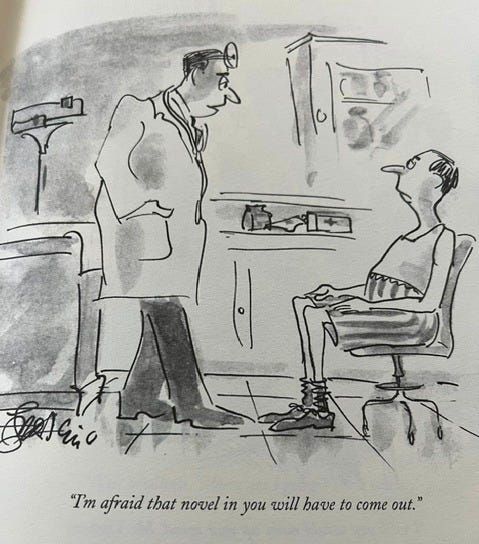
“How do I know what I think till I see what I say?” novelist E.M. Foster asked. His statement makes me laugh with its accuracy and deadpan attitude. Recently, the chair of The Writers’ Union of Canada, John Degen, published a book that was among the first to have “Human-Authored” on its cover.
I blinked when I first read this, and then, in the same week, I discovered a writer I greatly admire, Anthony Horowitz, uses ChatGPT “all the time” in writing his books. In an article published in The Independent, Horowitz said, “I feel nervous about it, because, is it cheating? I feel a bit like it’s cheating in a school exam.” So Degen’s stamp of owning every bit of his creativity may be one we’ll see more often. The slogan was developed by the Society of Authors, a U.K. trade union.
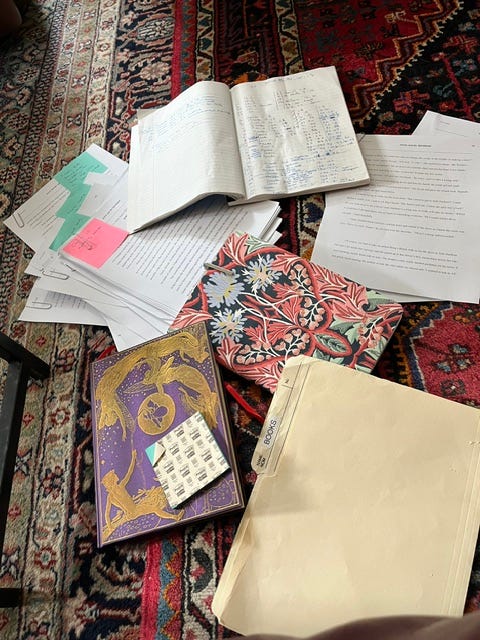
Meanwhile, here on Pender Island, I continue to beaver away at my novel, delighted at some of the peculiar twists the plot is taking. I am cheering on one character in particular as she edges toward a difficult decision. As I have difficulty sitting at my keyboard for a long time, I am writing by hand—and not, at the moment, worried about being replaced by AI. Rightly or wrongly, I consider myself quirkier. I do lament the loss in author and publisher income over the last number of years. In a 2025 survey, one source, SOUK, Shout Out Loud UK, cites 39% of novelists claim that GenAI has negatively affected their income. It is great for organizing End Notes; I’ve watched a writer pal use ChatGPT to whip hers into shape in less than a minute. It was a secretarial task that would’ve taken her hours.
Mia Ballard, the author of Shy Girl, had her book pulled by the publisher Hatchette in 2026 after it was demonstrated by an AI survey tool that up to 78% of the content could have been generated by AI.
The difference between Horowitz and Ballard’s situations is apparently “purpose, transparency and the extent of the AI’s involvement in the writing process.” It must be true because I asked Google and that’s what came up.
To go back to writers not knowing what they want to say until they write it, I think the argument that writers have with themselves, or the exploration, if you will, is more about values and connections than I’d previously realized. Here, specifically, I am thinking about our attitudes toward the land. How might I act if I understood that the land owned me?
Which in a sense, I do. This is a poem I wrote about a pivotal experience when I was younger.
LIFELONG
At seventeen, naked, you peer out a porthole
at firs and rock, surrounded by still water,
stamped with reflections, moving. Snowy mountains repeat
north and east. Distant points of land open
down multiple waterways: you’re in a Tony Onley print
only coloured like a Japanese fan. You’re dazed
with July. Calm sea, the jade whaleback of an island;
the first week of your commercial fishing career.
You are so green you don’t
know real fishers rise at four a.m. It’s now
six. So you Ooo over the island, your mouth the mirror
of the porthole’s brass “O”, ask your red-shirted boyfriend
who’s been up for half an hour, has trolling lines
in the water, and is, in your estimation, heroic,
beams out knowledge like a lighthouse flashes
every so many seconds, to show you on the chart where you are.
Kinghorn Island. The softness of morning slots you home
in a way you don’t understand. Your heart twists
like a key’s turned in a lock: what just happened?
Back at the porthole, you touch fingertips to lips, blow
a kiss to shore, say, I’m going to learn this
coast. Wherever I wake up, I’m going to know where I am,
a promise that makes you smile now, close to fifty
years later, for its brashness. At seventeen,
did you acknowledge these waters as your true love
(the slow happiness of a body where it should be)
or did the coast claim you first? Whatever transpired
in that substantive instant
of give and take, of adoration,
you remain open, posture soft,
to green-beckoning headlands, the coast’s glittering world.
I still look at the BC coast as “my true love.” Some of the characters in the Jorrie books feel the same way about Satter Island, where most of the stories unfold. It’s a magical steam-punk version of where I live.
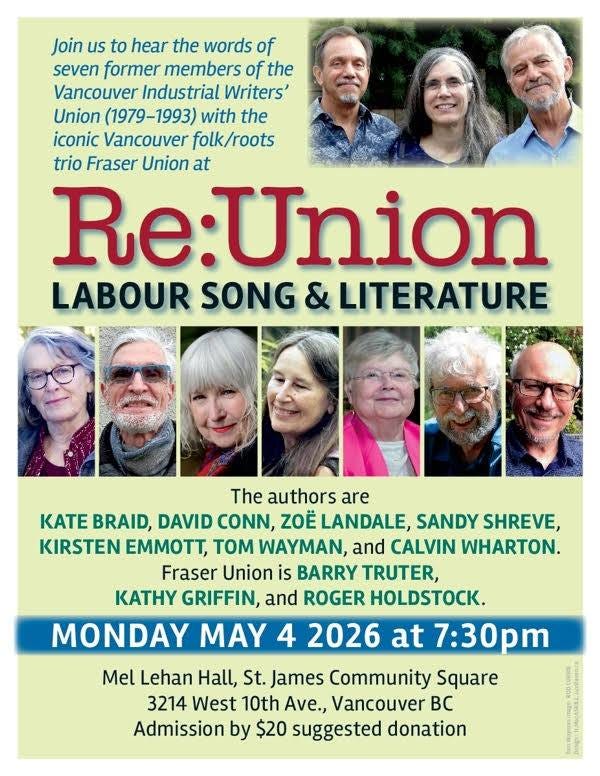
Last week I had the opportunity to participate in a 30-year reunion of writers and musicians from my past. The Vancouver Industrial Writers’ Union, VIWU, and the band Fraser Union put on a concert in Vancouver. Fraser Union do wonderful songs of BC history and working women and men. Their website says, “Music celebrating lives past and present.” Here’s a lovely song of theirs on YouTube called “Bank Trollers.”
That evening of our concert when I listened to people singing and reading about the values of the bonds we form with one another, and to the land, I felt so appreciative. Everyone I know is dealing with apprehension about what terrible thing will be in the news each day. After the concert, one of Fraser Union’s members, Barry Truter, encapsulated the evening by saying, “This is a coming together in the face of what’s going on in the world.” We chatted for a bit longer, then Barry finished by saying, “It’s called solidarity.” And I thought of my friends and neighbours while I watched the audience members dispersing. It seemed everyone there had come because they knew someone performing that night and wanted the value and the affirmation of coming together.
So here’s to music, to writing and our connections with one another and the land, and valuing the bright caring which gives meaning to our lives!